1.Main knowing about CNC rotary axis
A CNC rotary axis is a motion axis of a computer numerical control machine that generates rotational movement rather than linear translation. While conventional axes (X, Y, Z) move a tool or workpiece along straight lines, a rotary axis turns a component around a fixed centerline, with angular position measured in degrees or radians.These axes can operate independently or simultaneously with linear axes to produce complex three?dimensional shapes, undercut features, and parts with curved surfaces that would be impossible to machine with only linear motions.
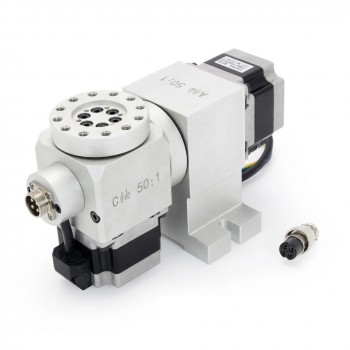
2.Working steps of CNC rotary axis
1.Command generation:The CNC part program calls a rotary axis move, e.g., G01 A90.0 F500. This commands a 90 rotation at 500 degrees per minute.
2.Interpolation:The controller calculates the required acceleration, constant speed, and deceleration phases. It also coordinates with linear axes if a simultaneous move is programmed.
3.Signal output:The controller sends velocity or torque commands to the servo drive, often via analog ±10V or digital fieldbus.
4.Motor rotation:The servo motor turns, and the gear reducer multiplies torque while reducing speed. The output shaft begins rotating.
5.Feedback loop:The angular encoder continuously reports the actual position to the drive and controller. Any deviation is corrected by the servo loop.
6.Clamping:For heavy cutting operations at a fixed angle, the brake is applied after positioning, locking the axis rigidly.
7.Completion:When the commanded angle is reached, the controller holds the position until the next move.
3.Main functions of CNC rotary axis
1.Realizing multi face machining in a single setup:The CNC rotary axis support multi-face machining under one clamping condition. This is one of its most practical and economically significant contributions.With a rotary axis, several faces can be indexed or continuously oriented during one setup.
2.Enabling the machining of complex curved and freeform surfaces:The rotary axis plays a decisive role in machining freeform geometries such as turbine blades, impellers, molds, medical implants, and aerospace structural parts.With a rotary axis, several faces can be indexed or continuously oriented during one setup.
3.Improving cutting conditions and distributing tool load more intelligently:A less discussed but highly important function of the rotary axis is its ability to improve cutting mechanics. By rotating the workpiece or adjusting tool orientation, the system can maintain a more stable entry angle, chip thickness, and cutter engagement condition.
4.Supporting indexed machining and continuous interpolation:The CNC rotary axis generally works in two typical modes: indexed positioning and continuous interpolation. In indexed mode, the axis rotates to a target angle, locks or holds position, and the other axes perform the cutting.
5.Reducing setup dependency and enhancing process integration:A major function of the rotary axis is to compress process chains. Features that would otherwise be split among milling, drilling, helical interpolation, angular positioning, and secondary finishing operations can often be merged into a more integrated cycle.
6.Enhancing automation and compatibility with advanced CAM strategies:The CNC rotary axis also serves as a foundation for advanced CAM programming. Toolpath strategies such as swarf milling, flank milling, spiral wrapping, rotary engraving, and adaptive multi-axis finishing all depend on controlled angular motion.
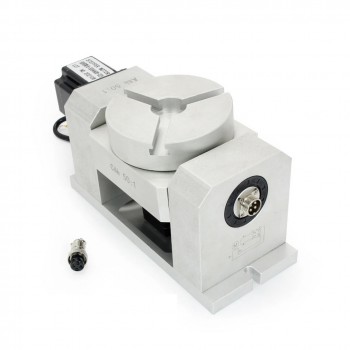
4.Selection principles of CNC rotary axis
1.Match the rotary axis to the actual machining task:The first principle is that the rotary axis must serve the machining objective rather than exist as an isolated accessory. Different machining tasks impose very different requirements on the rotary axis.
2.Give priority to load capacity under real working conditions:One of the most important selection principles is to evaluate load not by the nominal workpiece weight alone, but by the actual loading state during machining. In rotary axis applications, the load is rarely just a static vertical mass.
3.Ensure compatibility with the machine tool structure:A rotary axis cannot be selected independently from the host machine. It must be compatible with the machine tool in terms of installation interface, table size, axis travel, spindle access, control system support, and overall structural proportion.
4.Rigidity should be valued more than short term speed advantage:In many applications, especially metal cutting, rigidity should be treated as a primary principle in rotary axis selection. This includes structural stiffness of the body, bearing support capacity, clamping rigidity, braking stability, and resistance to vibration under interrupted cutting.
5.Consider drive mode according to process characteristics:Different rotary axes use different drive mechanisms, such as worm gear drive, direct drive, or other transmission structures. Their performance differs in terms of torque output, backlash behavior, maintenance difficulty, speed response, and cost.
6.Clamping and support method must suit the workpiece form:The rotary axis must also be selected according to how the workpiece will be held and supported. This principle is often overlooked in early planning, but in actual use it strongly affects accessibility, rigidity, balance, and setup efficiency.
7.Keep enough margin for future process expansion, but avoid blind oversizing:A sound selection should consider not only the current part family, but also foreseeable future tasks. If the chosen rotary axis is too narrowly matched to one existing product, the system may soon become restrictive when workpiece size, material, or machining complexity changes.