1.What is a harmonic reducer gearbox?
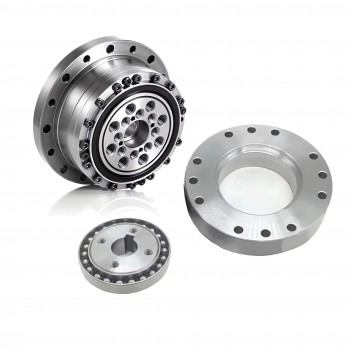
A harmonic reducer gearbox is a precision mechanical speed reduction system that exploits the elastic deformation of a flexible metal component to achieve very high reduction ratios in a single, compact stage, with zero backlash, coaxial input and output, and high torque density.Unlike conventional gearboxes that rely on rigid tooth to tooth contact between rotating elements, a harmonic reducer transmits motion through a controlled, moving wave of elastic deflection.
2.Working principles of harmonic reducer gearbox
1.High speed power input:The servo or stepper motor drives the wave generator to rotate at high speed, which is the input part of the harmonic reducer.
2.Elastic deformation generation:The elliptical cam of the wave generator pushes the thin walled flexspline to produce controllable elastic deformation, turning the round flexspline into an elliptical shape.
3.Partial tooth meshing:At the long axis of the ellipse, the outer teeth of the flexspline fully mesh with the inner teeth of the fixed circular spline; at the short axis, the teeth are completely separated.
4.Continuous meshing position shift:With the continuous rotation of the wave generator, the elliptical deformation position moves circumferentially, making the gear meshing area rotate synchronously around the circumference.
5.Speed reduction by tooth difference:The circular spline has 2 more teeth than the flexspline. Due to the tooth quantity difference, each full rotation of the wave generator makes the flexspline produce a tiny relative rotation.
6.Low speed high torque output:The slowly rotating flexspline outputs stable low speed and amplified torque, realizing precise deceleration, zero backlash transmission and precise positioning.
7.Stable cyclic operation:The whole process repeats continuously with elastic deformation, realizing long term smooth, low vibration and high precision transmission.
3.Main functions of harmonic reducer gearbox
1.High torque transmission in compact form:One of the primary functions of a harmonic reducer gearbox is to transmit high torque in a compact and lightweight form. This feature makes harmonic reducers ideal for applications where space is constrained but high performance is required.
2.Precise motion control:Harmonic reducers are known for their exceptional precision and minimal backlash. Their unique mechanism, which involves the use of flexible gears and a wave generator, allows for precise control over rotational movement. This precision is crucial in applications such as robotics, CNC machines, and automated assembly lines.
3.High reduction ratios with minimal gear stages:A key characteristic of harmonic reducers is their ability to achieve extremely high reduction ratios.Harmonic reducers, however, can provide high reductions in a single, compact stage, improving efficiency and reducing mechanical losses.
4.Backlash elimination:The unique design of the harmonic reducer helps minimize or eliminate backlash, a common problem in traditional gear mechanisms. Harmonic reducers achieve virtually zero backlash due to their compliant gear system, making them ideal for systems where high precision and repeatability are essentia.
5.Load distribution for enhanced durability:In a harmonic drive, the load is distributed across the entire surface of the flex spline, which ensures even stress distribution. This design reduces the likelihood of gear wear, increases the lifespan of the gearbox, and enhances the durability of the entire system.
6.Energy efficiency:Harmonic reducers are highly efficient in converting input power into output motion with minimal energy loss. Unlike traditional gear systems, which may suffer from inefficiencies due to friction and heat generation, harmonic reducers maintain high efficiency even at high reduction ratios.
7.Compactness and lightweight design:The design of harmonic reducers allows them to achieve significant torque output in a smaller footprint than conventional gearboxes. Their ability to fit high reduction ratios into a compact, lightweight structure makes them particularly useful in applications with limited spaces.
4.Common faults of harmonic reducer gearbox
1.Excessive backlash:While harmonic reducers are designed to minimize or eliminate backlash, excessive backlash can still occur in certain situations. Over time, the flex spline, which is responsible for transmitting power, can deform or degrade, causing the gears to lose their tight mesh and resulting in noticeable backlash.
2.Overheating:Overheating is a common issue that can affect the overall performance of harmonic reducers, particularly when they are operating under heavy loads or at high speeds. When a harmonic reducer generates excessive heat, it can result in the breakdown of lubricants, the degradation of materials, and even the failure of critical components.
3.Lubrication failures:Lubrication is vital to the smooth operation of harmonic reducers. If the lubricant fails, whether due to contamination, improper viscosity, or a lack of lubrication, it can lead to increased friction, higher wear rates, and eventually gearbox failure.
4.Gear tooth wear and damage:Gear tooth wear is a common issue that can arise in harmonic reducers, particularly in high-load applications. The flex spline and other gears experience constant stress, which can lead to the gradual erosion or deformation of the gear teeth.
5.Misalignment:Misalignment of the input and output shafts or the internal gears can cause significant issues with harmonic reducer gearboxes. Misalignment may lead to uneven loading on the gears, increased friction, and the development of unnecessary stress on critical components, resulting in reduced efficiency and premature wear.
6.Noise and vibration issues:Excessive noise and vibration are indicators of potential faults within a harmonic reducer. While harmonic reducers are generally known for their quiet operation, abnormal noise and vibrations can arise due to misalignment, damaged gears, or insufficient lubrication.